
Vic ‘adult time for violent crime’ laws for children incompatible with human rights, attorney-general admits
Benita Kolovos
Victoria’s attorney-general, Sonya Kilkenny, has admitted the government’s “adult time for violent crime” bill is incompatible with the state’s charter of human rights.
Kilkenny introduced the bill to parliament on Tuesday, which, if passed, will uplift several serious crimes committed by children as young as 14 from the children’s court to adult courts. As a result, the maximum penalty for teenagers convicted of offences such as aggravated home invasions and carjackings will increase from three years to 25 years.
The bill has been roundly criticised by legal and human rights groups who say it will have a detrimental impact on already vulnerable young people and will disproportionately affect First Nations children.
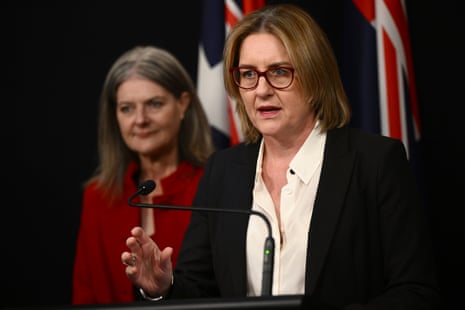
Even Kilkenny, in her compatibility statement tabled in parliament, admitted as much. Her statement reads:
The bill, as introduced to the Legislative Assembly, is in part, incompatible with the human rights set out in the Charter. The measures in the bill constitute significant limits on the fundamental rights of children who are by their nature a vulnerable cohort, which require a very high standard of justification in order to be compatible with rights.
While it is my strong view that the bill is necessary to address compelling and pressing community safety concerns brought about by unprecedented incidents of serious and violent offending by children, my acknowledgement of incompatibility accepts the inherent difficulty in meeting this high standard of justification.
The government has allocated just one hour to debate the legislation in the lower house before it is voted on. It will then be sent to the upper house, with Kilkenny and the premier, Jacinta Allan, telling reporters earlier this morning that the parliament would not rise until it passed. The Coalition have indicated they will support the bill.
It comes as more than 100 legal, human rights, social services and community groups signed a joint letter to Allan on Tuesday describing the changes as a “serious step backwards for Victoria”. It reads:
They ignore strong evidence about child development, rehabilitation and human rights, and will cause lifelong harm while making our communities less safe.
Key events

Anne Davies
Sloane says gambling policy will be announced before election
NSW Opposition leader, Kellie Sloane, now says there is no backtracking on the Opposition’s gambling policy, despite her interview with the ABC earlier in the day, that the Perrottet era policy was “under review.”
A spokesman for Sloane said “nothing has been watered down. The issue is that the technology has changed. Our policy will be announced closer to the election.”
Sloane told the ABC earlier that:
When the Coalition came to the last election, Dominic Perrottet, who was the premier at the time, proposed cashless gaming. That’s something we’ll review at the moment. But we’ve, we’ve had a strong and principled stand on that, you know, very happy to work with industry to look at a policy that will be, you know, have a real impact on the ground, a real and genuine reduction in problem gambling and harm, you know, harmful gambling practices in our state.
I think we have to review it, because the technology has changed in the last few years, but what we are committed to is addressing problem gambling; that hasn’t changed.
Vic ‘adult time for violent crime’ laws for children incompatible with human rights, attorney-general admits

Benita Kolovos
Victoria’s attorney-general, Sonya Kilkenny, has admitted the government’s “adult time for violent crime” bill is incompatible with the state’s charter of human rights.
Kilkenny introduced the bill to parliament on Tuesday, which, if passed, will uplift several serious crimes committed by children as young as 14 from the children’s court to adult courts. As a result, the maximum penalty for teenagers convicted of offences such as aggravated home invasions and carjackings will increase from three years to 25 years.
The bill has been roundly criticised by legal and human rights groups who say it will have a detrimental impact on already vulnerable young people and will disproportionately affect First Nations children.
Even Kilkenny, in her compatibility statement tabled in parliament, admitted as much. Her statement reads:
The bill, as introduced to the Legislative Assembly, is in part, incompatible with the human rights set out in the Charter. The measures in the bill constitute significant limits on the fundamental rights of children who are by their nature a vulnerable cohort, which require a very high standard of justification in order to be compatible with rights.
While it is my strong view that the bill is necessary to address compelling and pressing community safety concerns brought about by unprecedented incidents of serious and violent offending by children, my acknowledgement of incompatibility accepts the inherent difficulty in meeting this high standard of justification.
The government has allocated just one hour to debate the legislation in the lower house before it is voted on. It will then be sent to the upper house, with Kilkenny and the premier, Jacinta Allan, telling reporters earlier this morning that the parliament would not rise until it passed. The Coalition have indicated they will support the bill.
It comes as more than 100 legal, human rights, social services and community groups signed a joint letter to Allan on Tuesday describing the changes as a “serious step backwards for Victoria”. It reads:
They ignore strong evidence about child development, rehabilitation and human rights, and will cause lifelong harm while making our communities less safe.
Anne Davies
NSW opposition no longer supports cashless gaming
The newly appointed NSW opposition leader, Kellie Sloane, has walked away from a long-held Coalition policy in support of cashless gaming for NSW, which was championed by the former Liberal premier Dominic Perrottet.
Perrottet backed the system as the best way to deal with problem gambling and money laundering of illegal cash through poker machines. But he lost government before it could be implemented.
The Minns Labor government trialled the technology in 2023 and a three-person executive committee reported in September 2024, but its recommendations have not been actioned, amid strong resistance from the powerful clubs and pubs lobby.
The executive committee recommended that the NSW government introduce a mandatory statewide account-based gaming system, with a phased implementation approach allowing for voluntary adoption until a centralised system is fully operational, estimated to be by 2028.
Speaking on ABC Sydney Radio 702 on Tuesday morning, Sloane agreed with a caller that there was “a lot of pain and harm caused by problem gambling” and said she supported the new restrictions on hours at gambling venues that came into force recently.
But she said she would review the proposal for the cashless gaming card because technology had moved on.
When the Coalition came to the last election, Dominic Perrottet, who was the premier at the time, proposed cashless gaming. That’s something we’ll review at the moment. But we’ve, we’ve had a strong and principled stand on that, you know, very happy to work with industry to look at a policy that will be, you know, have a real impact on the ground, a real and genuine reduction in problem gambling and harm, you know, harmful gambling practices in our state.
I think we have to review it, because the technology has changed in the last few years, but what we are committed to is addressing problem gambling; that hasn’t changed.

Nick Visser
That’s all from me. Nino Bucci is back to take care of things for the rest of the afternoon. Take care!
‘Worst case scenario’ for incompatible triple zero Samsung devices on Optus at 470,000

Josh Taylor
The Australian Communications and Media Authority (Acma) says that Optus’s “worst case scenario” for Samsung devices on its network that may not be able to call triple zero is 470,000.
The figure was revealed in Senate estimates on Tuesday, following the telcos announcing in late October that dozens of older Samsung devices would not be able to call triple zero on the TPG network.
The telcos gave customers with such devices between 28 and 35 days to get new devices or upgrade their software, or face their devices being blocked from the network. TPG reported a Sydney man died last month after his Samsung device was unable to dial triple zero.
There has been no confirmed number of devices affected, but estimates at the time put it at about 50,000 across Australia. However, in Senate estimates on Tuesday, Acma officials said Telstra reported 114,527 devices on its network were affected and would be blocked between now and early January.
For Optus, it was having to go through a “manual process”, and officials said the “worst case scenario” was 470,000 devices.
Acma took questions on TPG figures on notice, noting that the risk factor was different for TPG customers, given they would not be able to call triple zero at all. In contrast, Optus and Telstra customers would be able to make calls on their respective networks, but not when camping on the TPG network if their networks were unavailable.
TPG blocked 5,389 devices on 16 October this year and 1,763 in late November. TPG moved to block the devices sooner, given that its customers were unable to call triple zero.
Acma said that constituted all of the devices on TPG’s network.
Benita Kolovos
Vic inquiry says group voting tickets ‘have had their day’ and should be abolished for 2026 election
A Victorian parliamentary inquiry has urged the government to immediately abolish the controversial group voting ticket (GVT) system and allow voters to preference multiple candidates above the line in upper house elections.
The electoral matters committee has tabled its report into the upper house voting system, arguing it’s time the state came into line with the rest of the nation and abolished GVTs.
Currently, voters mark one party above the line on the ballot paper. If that party is eliminated during counting, the party – not the voter – decides how their preferences will be distributed.
But the system has long been exploited, with backroom deals allowing little-known candidates to preference each other and then leapfrog rivals with 10 times as many first-preference votes.
The inquiry chair, Labor MP Dylan Wight, said the committee, community and stakeholders all agreed GVTs “have had their day”. He said:
They have led to votes being counted in ways that voters could not predict and may not have expected. Combined with the practice of ‘preference whispering’, they have undermined trust in our electoral system. Victoria is the last Australian jurisdiction to still use group voting tickets and it is time for us to remove them.
However, there was no consensus on what the upper house should look like without GVTs. While the inquiry examined six options, Wight said there was “no single model that satisfies all perspectives, and no single change that can be made without consequences for the balance of representation, accountability and fairness”.
The inquiry recommended a two-step process to immediately abolish GVTs in time for the 2026 election and allow voters to select multiple parties above the line. Then, a new process would be set up after the poll to “build agreement about what the electoral system should be”.
“If this process recommends changes to the electoral structure, a referendum could be conducted in 2028 or 2030,” the recommendation reads.
Guardian Australia has analysed each model proposed by the electoral matters committee using the actual vote totals in the 2022 election. You can see the results here:
Worker dead and teen seriously injured after wall collapse in Brisbane
A worker has been fatally crushed and a teenager seriously injured after a retaining wall collapsed during peak hour at an inner city building site in Brisbane, AAP reports.
The wall gave way as workers were on site just before 8.30am in Brisbane’s West End during construction. Two workers, 45 and 19, were trapped when the wall toppled, with the younger man pinned by his legs under massive concrete blocks.
Firefighters inflated special airbags around the injured man to raise the concrete to drag him free of the rubble.
The rescue operation took more than 90 minutes before the worker could be released and taken to the hospital in a stable condition with serious leg injuries.
The second man died at the scene.
Workplace Health and Safety Queensland is investigating, and police are preparing a report for the coroner.
Zinger kebabs help KFC operator lift sales
New time-limited menu items and flavours have helped a major KFC franchisee attract more customers and post double-digit profit growth, AAP report.
Collins Foods on Tuesday credited its Habanero Hot & Crispy boneless chicken, Zinger Kebab spicy chicken fillets and Sweet Tokyo teriyaki-style chicken with lifting sales.
Australian revenue grew 5% to $563.8m for the half-year to 12 October, with same-store sales up 2.3%.
Collins Foods opened another eight KFC restaurants in Australia during the half-year, bringing its total footprint to 292 nationally.
While the profits report ended in October, Collins and other franchisees will be hoping the bánh mì launched in November could be just as lucrative. You can read what we thought about it here:
Benita Kolovos
Victorian Greens urge government to scrap nominated entities instead of capping them
The Victorian Greens leader, Ellen Sandell, has urged the state government to abolish nominated entities used by major parties to fund election campaigns, rather than capping the amounts they can access.
It comes after the premier, Jacinta Allan, announced legislation this morning to limit major parties, including Labor, the Liberals and the Nationals, to withdrawing a maximum of $500,000 from the entities over an election period.
Sandell said:
Labor and the Liberals rigged the rules so they could access tens of millions in slush-fund money while everyone else was locked out. It’s dodgy, and Victorians are sick of it … If Labor were serious about fairness, it would scrap the slush funds.
Google to pay $55m over ‘anti-competitive’ telco agreements on search
Josh Taylor
The federal court has agreed to a joint proposal by the Australian Competition and Consumer Commission (ACCC) and Google Asia Pacific that the tech company pay $55m in penalties for anti-competitive conduct over agreements with Telstra and Optus to pre-install Google search on Android devices.
The understandings were in place between December 2019 and March 2021 and required the two telcos to only pre-install Google search on Android phones sold to customers.
In return, Telstra and Optus received a share of the revenue Google generated from ads in search results on those devices.
Google admitted it had engaged in anti-competitive conduct, and made joint submissions to the federal court with the ACCC on penalties, which the court ordered today.
ACCC deputy chair Mick Keogh said:
This penalty should send a strong message to all businesses that there are serious and costly consequences for engaging in anti-competitive conduct.
Google has also entered into an undertaking to remove pre-installation and search engine restrictions from Google’s contracts with Android phone manufacturers and telcos.
Telstra, Optus and TPG have also agreed not to renew or make new arrangements of a similar nature.

Natasha May
NSW Health defends social media policy covering private WhatsApp chats
Back in NSW health budget estimates, the Greens MLC Amanda Cohn has asked NSW Health why it was necessary to seek oversight of private communication, such as WhatsApp chats, in its social media policy.
In August, Guardian Australia revealed the doctors’ union concerns over this feature in the department’s draft policy.
The state’s health secretary, Susan Pearce, said staff had flagged “less than desirable” commentary in group chats, and that the department was concerned people were being exposed to it in the workplace.
The executive director of workforce planning at NSW Health, Richard Griffiths, said some WhatsApp groups had several hundred members, so it was “appropriate we build into policy because the reach of groups is so wide”.
Griffiths said NSW Health wished to guide staff on how to appropriately use social media, not to restrict it.

Sarah Basford Canales
Shoebridge criticises Segal over antisemitism definition
The Greens senator David Shoebridge has criticised the antisemitism envoy, Jillian Segal, over how antisemitism is defined, saying those who conflate genuine criticism of Israel with antisemitism “do the cause no credit”.
In a Senate estimates hearing this morning, the Greens senator asked why Segal relied on the International Holocaust Remembrance Alliance’s (IHRA) definition for her report. IHRA’s working definition suggests antisemitism can include holding Jews collectively responsible for actions of the state of Israel and drawing comparisons of contemporary Israeli policy to that of the Nazis.
Shoebridge said:
I would join with anybody to fight antisemitism … genuine antisemitism. But when you and others conflate legitimate criticism of … the state of Israel, it’s appalling genocidal behaviour against Palestine. When you conflate that with antisemitism, you do the cause no credit.
The Liberal senator Paul Scarr interjected to make a point of order, requesting whether Shoebridge could “simply limit himself to asking questions rather than giving soliloquies”.
Segal said IHRA’s definition “makes it very clear that legitimate criticism of Israel in the same form as you would criticise another state is not antisemitic”.
She continued:
So, legitimate criticism is fine, and I think that has been a misunderstanding generally by some people in relation to what is permitted by IHRA, and hence, has resulted in very unfair criticism of IHRA.
Antisemitism envoy says ‘perhaps I should have’ issued press release after neo-Nazi rallies
Sarah Basford Canales
The antisemitism envoy, Jillian Segal, says she told individual media outlets she condemned recent neo-Nazi rallies but conceded she could have made a broader statement.
At a Senate estimates hearing on Tuesday, the Greens senator David Shoebridge questioned her public response to the rallies:
I’ve seen you publicly condemn, put out proactive statements condemning, pro-Palestinian protests, but when the most high profile neo-Nazi protest is held out the front of a state Parliament House, you choose not to put a proactive public statement condemning it.
A proactive statement is industry jargon for a press release distributed to the media without being asked.
The envoy said the group’s actions were “quite despicable”, but she had been apprehensive about giving them more airtime than necessary.
Segal said:
I did convey to various news outlets who asked – those who approached me for a condemnation. I had a statement prepared. I did not put out a press statement. And you know, I note that perhaps I should have, to make it clear, but news outlets that did contact my office, I did convey that.
It’s a movement, as you say, grounded in hate and intimidation. And they just, they are absolutely seeking to disrupt public life, destroy our social cohesion. I was initially, I might say, reluctant to give them more airplay, but I take your point because they do crave notoriety.
Perhaps there should have been a broader statement, but I chose to do it through individual media responses, but be under no illusion, I do condemn them.

Patrick Commins
Queensland average home price passes $1m
The average Queensland home price has passed $1m for the first time, according to the Australian Bureau of Statistics’ latest stocktake on the total value of the country’s residential property market.
Queensland is the second state, after NSW, to reach the depressing milestone for many Australians amid a national housing affordability crisis.
The total value of dwellings climbed by 2.7% in the September quarter to $11.9tn, up 60% over the past five years.
That compares with $4.3tn in total retirement savings, and this booming wealth is helping to underpin households’ confidence and spending, according to UBS economists.
The ABS data showed that in NSW, the average home price was nearly $1.3m, followed by Queensland at just over $1m, and the ACT at $968,000.
The lowest priced homes on average were in Northern Territory, at $564,000, followed by Tasmania at $669,000.
The average dwelling price in Western Australia was $948,000, in Victoria $919,000, and in South Australia $887,000.
Fatal WA fire has burnt 4200 hectares
Just a little more on that deadly fire in the south of Western Australia: according to emergency alerts, a watch and act warning is now in place for the blaze near West River.
It has burnt 4200 hectares (10378 acres), and 60 firefighters are at the scene working on containment lines, according to the latest warning.
Allow Facebook content?
This article includes content provided by Facebook. We ask for your permission before anything is loaded, as they may be using cookies and other technologies. To view this content, click ‘Allow and continue’.
Sarah Basford Canales
Foster says detention centre incident numbers ‘too many’ as reports show sharp increases
Over in Senate estimates this morning, the home affairs department secretary, Stephanie Foster, has acknowledged that the number of critical incidents in onshore immigration detention centres is “too many”.
The department’s latest annual report showed there were 59 critical incidents per 1,000 detainees over 2024-25 compared to 27.84 the year before, representing an 11.93% increase.
The report also showed an increase in the number of “sexual assault critical incidents” over 2024-25, rising to 30 from 19. The department’s report does not provide further details on whether the alleged perpetrators are detainees, staff or other persons.
The report highlighted a “correlation” between a higher rate of detainees with criminal histories (88.55%) and increases in the number of critical incidents.
However, Foster said:
The number of incidents is too many, and we need to keep working if we are to reduce that number. And there are a range of things that we have done over the past few months, and a range of things that we will continue to do that will help ameliorate that, and we can go through that in outcome three [later on Tuesday].
Read more: