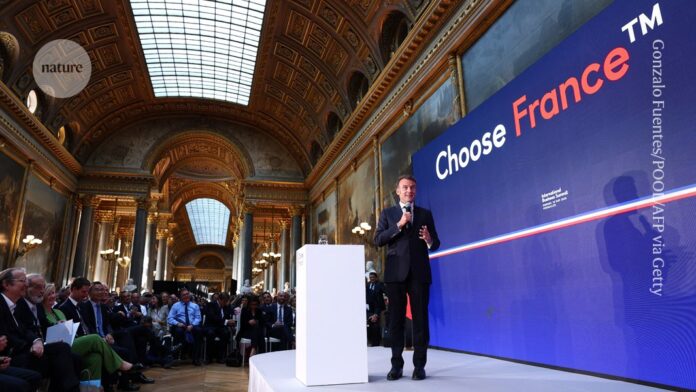

French President Emmanuel Macron has launched Choose France initiatives to attract both foreign investors and scientists to his country.Credit: Gonzalo Fuentes/POOL/AFP via Getty
France announced late last week that it would be awarding funds to 46 scientists as part of a high-profile initiative to recruit foreign researchers to the country with the promise of greater academic freedom. Almost all of them were previously at US institutions.
The more than €30-million Choose France for Science initiative, launched last April, is just one of a slew of European initiatives that aim to bring in research talent disaffected by changes elsewhere. These include the European Union’s Choose Europe initiative, which is currently supported by nearly €900 million (US$1.1 billion) in research funding. The French programme will see 41 of the 46 recruits relocate to France from the United States. Eight of these researchers worked at Columbia University in New York City, which last year saw hundreds of millions of dollars’ worth of its research grants cut and frozen by the administration of US President Donald Trump.
Some US researchers want to leave the country. Can Europe take them?
The award recipients include Zhongkai Tao, a mathematician studying the structures of waves and matter in physics. Previously at the University of California, Berkeley, Tao has now taken up his grant at the Institute of Advanced Scientific Studies (Institut des Hautes Études Scientifiques, or IHES) in Paris. Astrophysicist Kartik Sheth, who was associate chief scientist at NASA until he was fired by the agency during mass layoffs last year, has also been funded by the initiative. He will take up a three-year position at Aix-Marseille University.
Under Trump’s second presidency, US researchers have experienced grant cuts, the dismantling of science-funding agencies and increased federal control over universities. US foreign aid and awards to international collaborators have also been terminated. When announcing the call last year, Élisabeth Borne, then French minister for higher education and research, said that France would offer a “refuge” to researchers as “science and research face unprecedented threats worldwide”.
The high proportion of US scientists among those recruited by the programme shows that “enthusiasm and morale for doing science is low” in the United States, says Sharon Milgram, who led early-career researcher training and education programmes at the US National Institutes of Health (NIH) for nearly 20 years, until she retired in December.
Yet a few dozen vacating scientists are unlikely to make a large dent at US academic institutions, which altogether have more than 1.5 million faculty members, she says. France and other countries hoping to lure US scientists face an uphill battle: funders such as the NIH, with their multibillion-dollar budgets, are irreplaceable, Milgram adds. Tens of thousands of scientists, rather than dozens, would need to relocate for it to have a big, long-term impact on US science, she says.
Columbia University, which had most of its grants reinstated and unfrozen after the institution agreed to pay US$200 million to settle claims that it had failed to combat campus antisemitism, did not respond to Nature’s queries about its researchers leaving the institution.
Migrating researchers
Of the 46 award recipients, 19 are US nationals, 13 are French and 8 are originally from other European nations. The largest share are researchers studying climate, biodiversity and sustainable societies, according to the French Ministry of Higher Education and Research. The ministry declined to identify the 46 award recipients, citing safety reasons.
LINK: US grant applicants surge at prestigious European research agency
But it did reveal that almost half of those awarded funding are headed to higher-education institutions in and around Paris. And 12 are going to Aix-Marseille University, which launched its own ‘Safe Place for Science’ initiative, worth about €15 million. The university said that the programme was launched “in a context where some scientists in the United States may feel threatened or hindered in their research”.
Among them is Alka Patel, a historian of art and architecture, previously at the University of California, Irvine.
Meanwhile, Tao says he decided to move to France because the IHES is “a world-leading institute of mathematics” and he will be surrounded in Paris by a strong maths community. “Certainly, the Choose France funding shows that the French government supports researchers from all over the world,” he adds. With the funding, Tao says that he will establish a research group and study uncertainty principles and geometric spectral theory.